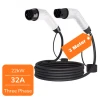
Type 2 EV charging cables are the unsung heroes of the EV world – think of them as the bridge between your car and clean energy. These connectors are the standard for home and public charging across Australia, Europe, and most of the world. This guide covers everything Australian EV owners need to know about Type 2 cables: compatibility, sizes, specifications, and how to choose the right cable for your vehicle and charger (no guesswork required).

What is a Type 2 EV Charging Cable?
A Type 2 connector (also called Mennekes connector) is the standard EV charging socket used in Australia, Europe, and most countries outside North America. Unlike Type 1 connectors used in some older vehicles, Type 2 supports both single-phase and three-phase charging, making it the most versatile option for Australian homes.
Type 2 vs Type 1: What’s the Difference?
Type 2 (Mennekes) is now the Australian standard. It features 7 pins and supports AC charging up to 32A. All modern EVs sold in Australia come with Type 2 sockets as standard.
Type 1 (J1772) is the vintage cable of the EV world – older, charming, and increasingly rare in Australia. It has 5 pins and supports AC charging up to 32A but is less flexible. You’ll only need Type 1 if you own a legacy EV (pre-2015 imports) or specific Japanese models – think of it as the cassette tape to Type 2’s streaming service.
Type 2 Cable Lengths: Which Size Do You Need?
Type 2 cables come in standard lengths designed for different home charging setups. Whether you’ve got a compact suburban driveway or a sprawling rural property, there’s a length that fits perfectly (we’ve got you covered). Here’s what Charge Wise Australia currently stocks:

Single-Phase (7kW) Type 2 Cables
Standard for homes with single-phase supply – that’s most Australian residences (if you’re not sure, it’s probably you). These cables match a 7kW wall charger:
- 3m cable: Ideal for chargers mounted close to parking spot
- 5m cable: Most common choice for suburban homes
- 7.5m cable: For driveways or distances up to 7.5 metres
Three-Phase (22kW) Type 2 Cables
For properties with three-phase power – the power-player upgrade (common in rural areas or homes where faster is better). These support the serious 22kW charging experience:
- 3m cable: Premium three-phase performance
- 5m cable: Standard three-phase installation
- 7.5m cable: Long driveways and detached garages
- 10m cable: Extended reach for larger properties
Availability changes — check the live stock status on each cable product page.
Australian Certification: AS/NZS Standards
All Charge Wise Type 2 cables are built and tested to IEC 62196-2 (EV connectors) and IEC 61851-1 (EV charging systems) — the international standards the Australian AS/NZS series is based on. This means:
- Safety tested for Australian electrical networks
- Compatible with all Type 2 vehicles and chargers sold in Australia
- Built to withstand Australian weather conditions
- Meet insurance and installation requirements
Always use Australian-certified cables. Non-compliant cables may void your warranty or fail safety inspections during installation.
Single-Phase vs Three-Phase Charging: Which Do You Have?
Your home’s electrical supply determines which Type 2 cable and charger you need:
Single-Phase (240V)
- Most common in Australian suburban homes
- Supplies 7-10kW maximum
- 7kW Type 2 cable is standard
- Charges most EVs fully overnight (8-10 hours)
Three-Phase (400V)
- Common on rural properties, farms, and premium homes
- Supplies up to 22kW or higher
- Requires 22kW Type 2 cable and three-phase charger
- Charges large EVs in 4-6 hours (significantly faster)
- Best for solar-only charging setups wanting maximum solar utilisation
Check your electricity bill or switchboard to confirm your supply type, or contact your electrician during installation assessment.
Type 2 Cable Specifications
All Charge Wise Type 2 cables share these core specifications:
- Connector type: Type 2 (Mennekes) – 7-pin
- Voltage: 230V (single-phase) or 400V (three-phase)
- Current: Up to 32A continuous
- Power output: 7kW (single-phase) or 22kW (three-phase)
- Cable gauge: 6mm² or 16mm² depending on phase
- Weather rating: IP54 – designed for Australian outdoor conditions
- Safety: Moulded, strain-relieved connectors with integrated pilot-contact (control pilot / proximity pilot) circuit. Note that RCD protection is provided by your charger and switchboard, not by the cable itself.
Type 2 Cable Compatibility: Which Vehicles Use Type 2?
Type 2 is the standard for virtually all modern EVs in Australia:
- Tesla (Australian imports): Model 3, Model Y, Model S – all use Type 2 via adapter or native socket
- BYD: ATTO 3, SONG Plus DM-i, and others
- BMW: i3, i4, iX
- Volkswagen: ID.3, ID.4, ID.5
- Hyundai/Kia: Ioniq 5, Ioniq 6, Kona Electric, EV6
- Audi: Q4 e-tron, A6 e-tron
- Mercedes: EQE, EQE SUV, EQA, EQC
- Nissan: Leaf (newer models), Ariya
- Renault: Zoe, Megane E-Tech
If your EV is manufactured after 2015 and sold in Australia, it uses Type 2. Our recommendation: always check your vehicle’s manual or charging port before purchasing a cable.
How to Measure Cable Length You Need
Choosing the right cable length prevents damage from strain and improves safety:
- Measure from your charger to your vehicle’s charging port – account for the vehicle parked in normal position
- Add 0.5–1 metre buffer – prevents cable tension and pulling
- Route around obstacles – pathways, driveways, garden edges
- Plan for future EV placement – will your next car park in the same spot?
For reference: most suburban homes need a 5m cable. Rural properties and larger blocks should consider 7.5m or 10m options.
Portable Type 2 Charging: The NORA Alternative
Need flexibility? Charge Wise also offers NORA portable EV chargers with built-in Type 2 connectors. The NORA range includes:
- NORA 7kW Travel Charger: Portable single-phase charging – perfect for road trips or renters
- NORA Adapter Kits: Add 10A, 15A, or 32A plug adapters for charging from standard household outlets
Portable chargers are ideal if you move frequently, travel interstate, or want backup charging at a second property.
Storage & Protection: Cable Holster
Proper storage extends cable life and keeps your charger area tidy. Charge Wise offers an EV Charger Cable Holder / Type 2 Holster Dock – a wall-mounted bracket that:
- Protects your cable from weather damage
- Prevents accidental tripping hazards
- Keeps your charger setup looking professional
- Reduces strain on connectors
Highly recommended for permanent installations and essential for long-term cable durability.
Type 2 Cable Care & Maintenance
Keep your Type 2 cable in top condition:
- Store properly: Coil loosely in a cable holster or shaded area – avoid kinks and sharp bends
- Check for damage: Before each use, inspect for cuts, cracks, or exposed wiring
- Keep connectors dry: Wipe dry if used in rain – Type 2 is weather-rated but excess moisture can degrade connectors
- Avoid extreme temperatures: Store indoors during extreme Australian heat or cold
- Don’t modify the cable: Use as-is – custom modifications void certification and warranties
Installing a Type 2 Charger: What You Need
Before ordering your Type 2 cable, confirm your charger setup:
- Wall charger: Are you using a 7kW NEO charger (single-phase) or 22kW NEO (three-phase)?
- Electrical supply: Confirmed single-phase or three-phase?
- Distance: How far from charger to typical parking spot?
- Professional installation: Have a licensed electrician install your charger before connecting the cable
Charge Wise provides installation referrals to certified local electricians across Australia. Contact us for a personalised recommendation.
Charge Wise Type 2 Cable Range
All our Type 2 cables are Australian-certified, durable, and backed by expert support. Browse our full range:
Frequently Asked Questions
Can I use a Type 2 cable with my Tesla?
Yes. Teslas delivered in Australia use a standard Type 2 (Mennekes) inlet for AC charging, so a standard Type 2 cable plugs straight in — no adapter needed. (The proprietary Tesla connector people sometimes refer to is the North American NACS plug, which is not used on Australian-delivered cars.) For DC fast charging, Australian Teslas use CCS2.
What’s the maximum charging time with a Type 2 cable?
Charging time depends on your EV’s battery size and cable power rating:
– Single-phase (7kW): 8–12 hours for a full 60kWh battery
– Three-phase (22kW): 3–5 hours for a full 60kWh battery
Is a longer cable slower than a shorter one?
No. A 10m Type 2 cable charges at the same rate as a 3m cable – charging speed depends on the cable’s amperage rating (32A max), not length. All Australian-certified Type 2 cables are equally fast.
Can I permanently leave my Type 2 cable connected?
Yes – modern Type 2 cables and vehicle onboard chargers are designed for this. However, regular storage in a cable holster extends longevity and keeps your installation neat and safe.
Need Help Choosing?
Type 2 cable selection depends on your home’s electrical setup and EV model. Charge Wise offers free personalised consultation to help you choose the right cable, charger, and installation approach.
Contact Charge Wise today – our EV experts will guide you through the process and connect you with certified Australian installers.
Shop Type 2 Cables at Charge Wise
Ready to upgrade your charging setup? We stock a full range of Australian-certified Type 2 charging cables:
Type 2 Cable Specifications Guide
All cables listed are built to the IEC 62196-2 connector standard and are suitable for home and public charging.
| Cable Length | Power Rating | Charge Time* (60kWh battery) | Best For |
|---|---|---|---|
| 3 metre | 22 kW (3-phase) | ~2 hours | Urban, standard install |
| 5 metre | 22 kW (3-phase) | ~2 hours | Longer driveways |
| 7.5 metre | 22 kW (3-phase) | ~2 hours | Very long distances |
| 10 metre | 22 kW (3-phase) | ~2 hours | Maximum reach |
*Charge times vary based on vehicle battery capacity and charger rating.